How to Safely install an Isolator on a Double-pole Structure
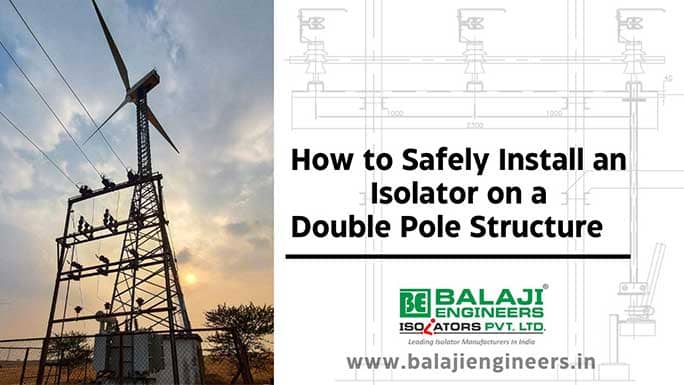
In this electrical blog we will see what is Isolator and how safely it can be installed on Double pole structure . In Substation Isolator is mounted on Four Pole pipe structure or lattice structure made up with angle, channels. But in some places it is mounted on Double ole structure . This is mainly in Wind farm , Solar , Industrial HT Consumer , Private industry , in Overhead line networks , in distribution lines etc.
Why Wind and Solar Prefer Double Pole Structures for Isolator Installation
Renewable energy projects like wind and solar farms prioritize double pole structures for isolator installations due to several unique advantages:
1. Space Efficiency:
Wind and solar installations are often in remote areas where space is limited or optimized for maximum energy output. Double pole structures are compact and ideal for such environments. In Wind mill Single Wind mill turbine having single isolation point i.e Air Break Isolator is used for isolation installed on double pole structure . Also in line of Wind mill to Substation Isolators are placed for purpose of Isolation over Double pole structures . Some times four pole structures are also used for Installation of Lightning arrester and Isolators .
2. 11 kV Double pole structure
3. 33 kV Double pole structure
In 33 kv Double pole structure mostly 152 X 152 RSJ Poles are used with hight of 9 Meter , 10 Meter , 11 Meter ,12 Meter ,13 Meter as per requirement of site and specifications provided by Electricla board and consultant company . RSJ poles are coloured with red oxide firstly than colour with Silver colour
4. Ease of Scalability
Understanding Double Pole Structures and Isolators
What is a Double Pole Structure?
A double pole structure is a support framework used in electrical systems with RSJ Poles , Cement Poles , Octagonal Poles, Conical Poles to carry high-voltage equipment, such as isolators, transformers, or circuit breakers. It consists of two parallel poles, typically made from durable materials like galvanized steel or reinforced concrete, designed to withstand environmental stresses and electrical loads.
11kV Double pole structure
22kV Double pole structure
33kV Double pole structure
Symmetrical Design : Provides stability and even load distribution for electrical components.
Compact Layout : Suitable for applications with space constraints, such as renewable energy projects.
Versatility : Commonly used in substations, transmission lines, and renewable energy installations like solar farms and wind farms.
Double pole structures are often chosen for their ability to support high-voltage isolators, ensuring safe and reliable operations in medium- to large-scale electrical systems.
Fabrication of Double Pole Structure for Isolator
The base of the isolators in the double pole structure are 75 x 40 channels. Mounted on Channel Peice, which is held up by Angle and Clam with bracing, are about 3500–4000 mm. The angle support’s bracing is made to handle both the entire isolator assembly and the base channel’s weight. To ensure precise guidance when operating the Box, an operation pipe guide must also be supplied. Additionally, the operation box must be properly positioned in the fabrication angle or channel, all the way down to the isolator. All angles and channels in the fabrication structure should be hot-dip processed up to 87 microns, and all fasteners should be high-grade stainless steel. Principal clearances should be maintained in Live part as well as in phase to phase .in 33 kv it is 1500 mm in between two phases .
What are Isolators in Electrical Systems?
Isolators, also known as disconnector switches, are mechanical devices used to isolate a section of an electrical circuit for maintenance, inspection, or fault management. They ensure safety by creating a physical gap in the circuit, which prevents current flow. BY Isolator we can visually confirm that high voltage current is passing or it is off in circuit at this present .
Types of Isolators Used in Double Pole Structures
Isolators used in double pole setups vary depending on the system’s voltage and operational requirements. Common types include:
1. Single Break Isolator
- Disconnects the circuit at a single point.
- Used in low- to medium-voltage applications.
- Tilting type ,Single break isolator
- 11 kV Air Break Switch 400 Amp
- 22 kV Air Break Switch 400 Amp
- 33 kV Air Break Switch 400 Amp
2. Double Break Centre rotating Isolator
- Provides two points of isolation in the circuit.
- Ensures additional safety and is widely used in high-voltage setups.
- Double Break Centre Rotating Isolator
- DBCR 11 kV Air Break Switch 400 Amp
- DBCR 22 kV Air Break Switch 400 Amp
- DBCR 33 kV Air Break Switch 400 Amp
- DBCR 11 kV Air Break Switch 800 Amp
- DBCR 22 kV Air Break Switch 800 Amp
- DBCR 33 kV Air Break Switch 800 Amp
- DBCR 11 kV Air Break Switch 1250 Amp
- DBCR 22 kV Air Break Switch 1250 Amp
- DBCR 33 kV Air Break Switch 1250 Amp
Step-by-Step Installation Guide for Electrical Isolators on a Double Pole Structure
Step 1: Preparing the Site and Checking the Structure
1. Site Preparation :
- Clear the installation area of any debris or obstacles.
- Ensure a stable foundation for the double pole structure.
- Verify that environmental conditions (e.g., wind and weather) are suitable for work.
2. Inspection of the Structure :
- Confirm that the double pole structure is securely erected and aligned.
- Check for structural integrity (no cracks or rust if metallic).
- Ensure the structure complies with load and safety standards for the isolator being installed.
- Must coloured with Red oxide and Silver paint before installation .
- Proper Fabrication for Isolator is designed and installed on Poles .
3. Safety Measures :
- Turn off power to the circuit where the isolator will be installed.
- Ensure proper grounding of the structure and tools.
- Equip personnel with appropriate PPE (helmets, gloves, insulated boots).
Step 2 : Mounting the Isolator on the Double Pole Structure
1. Positioning the Isolator :
- Identify the designated mounting location on the structure.
- Use a level to ensure proper alignment of the isolator.
- Isolator should handle carefully for its Insulator , Fixed Contact and Moving Contact assembly .
- Extra care to be taken for Porcelain type Insulator .
2. Securing the Mounting Base :
- Attach the isolator’s mounting brackets to the double pole structure using bolts or clamps. Base channels of 3200 to 3500 mm used for mounting of Isolator as per site and DP dimensions .
- Tighten fasteners to the manufacturer’s torque specifications to prevent slippage. SS hardware are preferably used for copper conductor path nut bolting and for fabrication Hot dip galvanized nut bolts are used .
3. Assembling the Isolator :
- Follow the manufacturer’s instructions to attach isolator components like arms, blades, or rotating mechanisms. Isolator Manufacturers like Balaji Engineers Isolators Private limited are provided Pre factory aligned Isolators , where Isolator links to be erected on structure and nut bolting of manual operation mechanism . Advantage of Balaji Isolator is Isolator come with alignment of Fixed contact and Moving Contact of Row , Also in case of Earth blade it is totally came duly alignment of Earth blade.
Step 3 : Connecting Electrical Cables and Terminals
1. Cable Or Conductor Preparation:
- Strip the insulation from cables to the appropriate length without damaging the core.
- Verify that cable sizes match the isolator’s specifications as per its ampre capacity .
2. Terminal Connections :
- Connect the input and output cables to the isolator terminals as per the circuit diagram.
- Ensure proper polarity and secure connections with appropriate torque to avoid loose joints.
- Termincal connector are palys very Important role in Isolator assembly on double pole . Connectors should be as per correct ampere rating with proper hole design .
3. Earthing Connections :
- Attach the grounding wire to the designated terminal on the isolator.
- Verify that the grounding path complies with safety standards
Step 4 : Testing and Ensuring Proper Functionality
1. Visual Inspection
- Check all connections for tightness and proper insulation.
- Verify that all moving parts (e.g., blades, switches) operate without obstruction.
- Confirm all Assembly , Insulators are in good condition after installation of total Isolator on Pole
- Alignment Fixed Contact and Moving Contact of Isolator to checked once .
2. Functional Testing :
- Operate the isolator manually or via the control mechanism to confirm smooth opening and closing.
- Use a multimeter to check for continuity and ensure the circuit is completely isolated when switched off.
- Manual 4 No 4 NC box is provided by Isolator Manufacturer , Rotary mechanical handle also provided some times . Operation system should be checked properly before its charging .
- Mechanical endurance Isolator ON OFF test is very important before charging of system.
3. System Integration :
- Reconnect power and perform load testing under controlled conditions.
- Verify that the isolator handles the rated current and voltage without any abnormalities.
4. Final Safety Checks :
- Test the isolator under fault conditions (if applicable) to ensure fail-safe operation.
Step 5 : Common Mistakes to Avoid During Isolator Installation
1. Misalignment During Installation Issue :
- Improper alignment of the isolator’s components (such as blades, terminals, or the operating mechanism) can lead to uneven operation or failure to establish a proper electrical connection
- Impact : Misaligned isolators may fail to isolate circuits effectively, increasing the risk of faults or accidents. They can also cause excessive wear on moving parts, shortening the lifespan of the equipment.
- Solution :
Use a level and alignment tools during installation.
Double-check that blades and contacts align correctly in both open and closed positions.
Follow manufacturer-recommended alignment procedures.
2. Loose Connections or Improper Wiring Issue:
- Loose terminals, incorrect cable sizing, or improper wiring practices can result in poor electrical contact, arcing, or overheating.
- Impact :These issues can cause equipment failure, energy losses, or fire hazards. In high-voltage setups, they may lead to catastrophic failures.
- Solution :
Ensure all terminals are tightened to the recommended torque specifications.
Use the correct cable size as specified in the isolator’s technical documentation.
Conduct a thorough inspection of all wiring before energizing the system.
Use crimping tools or appropriate connectors to avoid damaged or loose cable ends.
3. Ignoring Safety Protocols Issue :
- Skipping essential safety measures, such as not de-energizing the circuit, failing to wear personal protective equipment (PPE), or neglecting proper grounding, poses serious risks to personnel and equipment.
- Impact : Ignoring safety protocols can result in electric shocks, severe injuries, or equipment damage. Additionally, it may lead to non-compliance with local electrical codes.
- Solution :
Always de-energize the circuit and verify it with a voltage tester before starting work.
Wear PPE, including insulated gloves, boots, and helmets with visors.
Ensure proper grounding of the isolator and nearby structures to prevent stray voltage risks.
Follow lockout-tagout (LOTO) procedures to prevent accidental re-energization.
4. Final Safety Checks :
- Test the isolator under fault conditions (if applicable) to ensure fail-safe operation.
Additional Tips to Avoid Mistakes
- Not Following Manufacturer’s Instructions :Always adhere to the isolator’s manual for specific installation and operational requirements.
- Neglecting Environmental Factors : Consider site-specific conditions like wind, rain, or corrosive environments and use isolators designed for such scenarios.
- Insufficient Testing : Failing to test the isolator after installation can lead to undetected issues. Conduct thorough functional and load tests before commissioning.
Frequently Asked Questions About Isolator Installation
1. What is the purpose of an electrical isolator?
An electrical isolator is a mechanical switch designed to physically disconnect a part of a circuit to ensure safe maintenance or repair. Unlike circuit breakers, isolators do not interrupt electrical loads but are used to isolate sections after power is turned off.
2. What tools are required to install an isolator?
The tools typically needed include:
- Insulated wrenches and screwdrivers
- Voltage testers or multimeters
- Cable cutters and strippers
- Torque wrenches for securing connections
- PPE like insulated gloves, boots, and helmets
3. How do you ensure the isolator is properly aligned during installation?
To ensure alignment:
- Use a spirit level and alignment markers.
- Confirm that the isolator blades and fixed contacts meet perfectly in the closed position.
- Test the operation (manually or via mechanism) for smooth and consistent movement.
4. Can an isolator be installed outdoors?
Yes, isolators can be installed outdoors if they are designed for such environments. Outdoor isolators are typically weather-resistant, with protective enclosures to guard against rain, dust, and temperature extremes. Verify the IP (Ingress Protection) rating for outdoor suitability.
5. What are the safety precautions to follow during isolator installation?
- De-energize the circuit and use lockout-tagout (LOTO) procedures.
- Verify zero voltage using a tester before starting work.
- Use appropriate PPE, such as gloves and insulated tools
- Ensure the structure is properly grounded
6. Can I install an isolator without earthing ?
Earthing is required for equipment safety as will as human ,technicians safety . Good quality earthing shold be provided for Isolators , Lighting arrester and other equipment .
7. What is the difference between a single-pole and double-pole isolator?
Single-Pole Isolator: Disconnects only one side (phase) of a circuit
Double-Pole Isolator: Disconnects both the live and neutral wires for complete isolation, offering additional safety.
8. How do you test an isolator after installation?
- Perform a continuity test with a multimeter to ensure the circuit opens and closes properly.
- Manually operate the isolator to confirm smooth switching.
- Conduct a functional test under controlled load conditions
9. What are common installation mistakes to avoid?
- Misalignment of blades and contacts.
- Loose terminal connections or incorrect cable sizing.
- Ignoring grounding requirements or skipping safety protocols.
10. How often should an isolator be inspected or maintained?
Routine inspections should be carried out at least annually for normal systems. For critical or high-voltage setups, inspections may be needed every 6 months. Maintenance includes cleaning, checking for wear, and testing operation.
11. Which is the Top Brand of Isolator in India ?
Balaji Engineers Isolators private limited is top Brand of Isolator in India , Balaji Isolators are manufacturing 11kv,22kV,33kV,66kV,110kV,132kV,220 kV Isolators in India . visit – www.balajienigneers.in/isolators
Electrical isolator installation | Double pole structure isolator | How to install an isolator | Isolator installation guide | Electrical isolator safety tips | High-voltage isolator setup | Renewable energy isolator installation | Isolator installation for solar systems | Isolator installation for wind farms | Step-by-step isolator installation | How to safely install a double pole electrical isolator | Importance of isolators in renewable energy projects | Common mistakes during electrical isolator installation | Testing and maintenance of isolators in substations | Installing isolators for industrial and residential systems
Balaji Isolators are widely used and Approved in
Punjab
- Distribution : Punjab State Power Corporation Limited (PSPCL)
- Transmission : Punjab State Transmission Corporation Limited(PSTCL)
Haryana
- Dakshin Haryana Bijli Vitran Nigam (DHBVN), Uttar Haryana Bijli Vitran Nigam (UHBVN)
- Transmission : Haryana Vidyut Prasaran Nigam Limited (HVPNL)
Rajasthan
- Distribution : Jaipur, Ajmer, and Jodhpur Vidyut Vitran Nigam Limited (JVVNL, AVVNL, JdVVNL)
- Transmission : Rajasthan Rajya Vidyut Prasaran Nigam Limited (RVPN)
Uttar Pradesh
- Distribution : Uttar Pradesh Power Corporation Limited (UPPCL)
- Transmission : Uttar Pradesh Power Transmission Corporation Limited (UPPTCL)
Delhi
- Distribution : BSES Yamuna, BSES Rajdhani, Tata Power Delhi Distribution Limited (TPDDL)
- Transmission : Delhi Transco Limited (DTL)
Himachal Pradesh
- Distribution : Himachal Pradesh State Electricity Board Limited (HPSEBL)
- Transmission : Himachal Pradesh Power Transmission Corporation Limited (HPPTCL)
Jammu & Kashmir
- Distribution : Jammu Power Distribution Corporation Limited (JPDCL), Kashmir Power Distribution Corporation Limited (KPDCL)
- Transmission : J&K Power Transmission Corporation Limited (JKPTCL)
Maharashtra
- Distribution : Maharashtra State Electricity Distribution Company Limited (MSEDCL), Adani Electricity Mumbai Limited
- Transmission : Maharashtra State Electricity Transmission Company Limited (MSETCL)
Gujarat
- Distribution : Dakshin Gujarat Vij Company Limited (DGVCL), Uttar Gujarat Vij Company Limited (UGVCL), Madhya Gujarat Vij Company Limited (MGVCL), Paschim Gujarat Vij Company Limited (PGVCL)
- Transmission : Gujarat Energy Transmission Corporation Limited(GETCO)
Madhya Pradesh
- Distribution : Madhya Pradesh Paschim Kshetra Vidyut Vitaran Co. Ltd (MPPKVVCL), Madhya Pradesh Madhya Kshetra Vidyut Vitaran Co. Ltd (MPMKVVCL), Madhya Pradesh Poorv Kshetra Vidyut Vitaran Co. Ltd (MPPoKVVCL)
- Transmission: Madhya Pradesh Power Transmission Company Limited (MPPTCL)
Goa
- Distribution : Goa Electricity Department
- Transmission : Goa Transmission Subdivision (operational under a unified framework)
Tamil Nadu
- Distribution & Transmission: Tamil Nadu Generation and Distribution Corporation (TANGEDCO), Tamil Nadu Transmission Corporation (TANTRANSCO)
Karnataka
- Bangalore Electricity Supply Company Limited (BESCOM), Mangalore Electricity Supply Company Limited (MESCOM), Hubli Electricity Supply Company Limited (HESCOM), Chamundeshwari Electricity Supply Corporation (CESC), Gulbarga Electricity Supply Company Limited (GESCOM)
- Transmission : Karnataka Power Transmission Corporation Limited (KPTCL)
Kerala
- Distribution & Transmission: Kerala State Electricity Board (KSEB)
Andhra Pradesh
- Distribution : Andhra Pradesh Southern Power Distribution Company Limited (APSPDCL), Andhra Pradesh Eastern Power Distribution Company Limited (APEPDCL)
- Transmission :Transmission Corporation of Andhra Pradesh (APTRANSCO)
Telangana
- Distribution : Telangana State Southern Power Distribution Company Limited (TSSPDCL), Telangana State Northern Power Distribution Company Limited (TSNPDCL)
- Transmission :Transmission Corporation of Telangana Limited (TSTRANSCO)
West Bengal
- Distribution : West Bengal State Electricity Distribution Company Limited (WBSEDCL), CESC Limited
- Transmission : West Bengal State Electricity Transmission Company Limited (WBSETCL)
Odisha
- Distribution : TP Northern Odisha Distribution Limited (TPNODL), TP Central Odisha Distribution Limited (TPCODL), TP Southern Odisha Distribution Limited (TPSODL), TP Western Odisha Distribution Limited (TPWODL)
- Transmission : Odisha Power Transmission Corporation Limited (OPTCL)
Bihar
- Distribution : North Bihar Power Distribution Company Limited (NBPDCL), South Bihar Power Distribution Company Limited (SBPDCL)
- Transmission: Bihar State Power Transmission Company Limited (BSPTCL)
Jharkhand
- Distribution : Jharkhand Bijli Vitran Nigam Limited (JBVNL)
- Transmission : Jharkhand Urja Sancharan Nigam Limited (JUSNL)
Chhattisgarh
- Distribution : Chhattisgarh State Power Distribution Company Limited (CSPDCL)
- Transmission :Chhattisgarh State Power Transmission Company Limited (CSPTCL)
Assam
- Distribution : Assam Power Distribution Company Limited (APDCL)
- Transmission : Assam Electricity Grid Corporation Limited (AEGCL)
Meghalaya
- Distribution & Transmission : Meghalaya Energy Corporation Limited (MeECL)
Tripura
- Distribution & Transmission : Tripura State Electricity Corporation Limited (TSECL)
Manipur & Mizoram
- Distribution & Transmission : Jointly managed under Manipur State Power Company Limited (MSPCL) and Mizoram Power Department.
Nagaland, Arunachal Pradesh, Sikkim
- Unified systems under state electricity departments.
- Arunachal Pradesh Power Department (APPD).
- Sikkim Power Department (SPD).